← Home

Working through
mathematics

A few pieces of my mathematical work: explorations, attempts at problems, and handwritten proofs.

A hundred values
of φ(n)

I calculated Euler’s totient function for the first hundred positive integers by hand, looking for patterns. The prime cases gave φ(p) = p − 1; from there I began working through multiplicative order and primitive roots.

The calculation is simple to state: φ(n) counts the positive integers up to n that share no factor with n other than 1.

Some of my work.
Including the attempts.

A couple of problems I’ve worked through, and what changed as I worked on them. There’s a small example to try, too.

Rearrangements
& parity

From my work in 2026

A moving
target

From my work in 2025

Can a set and a number
carry the same information?

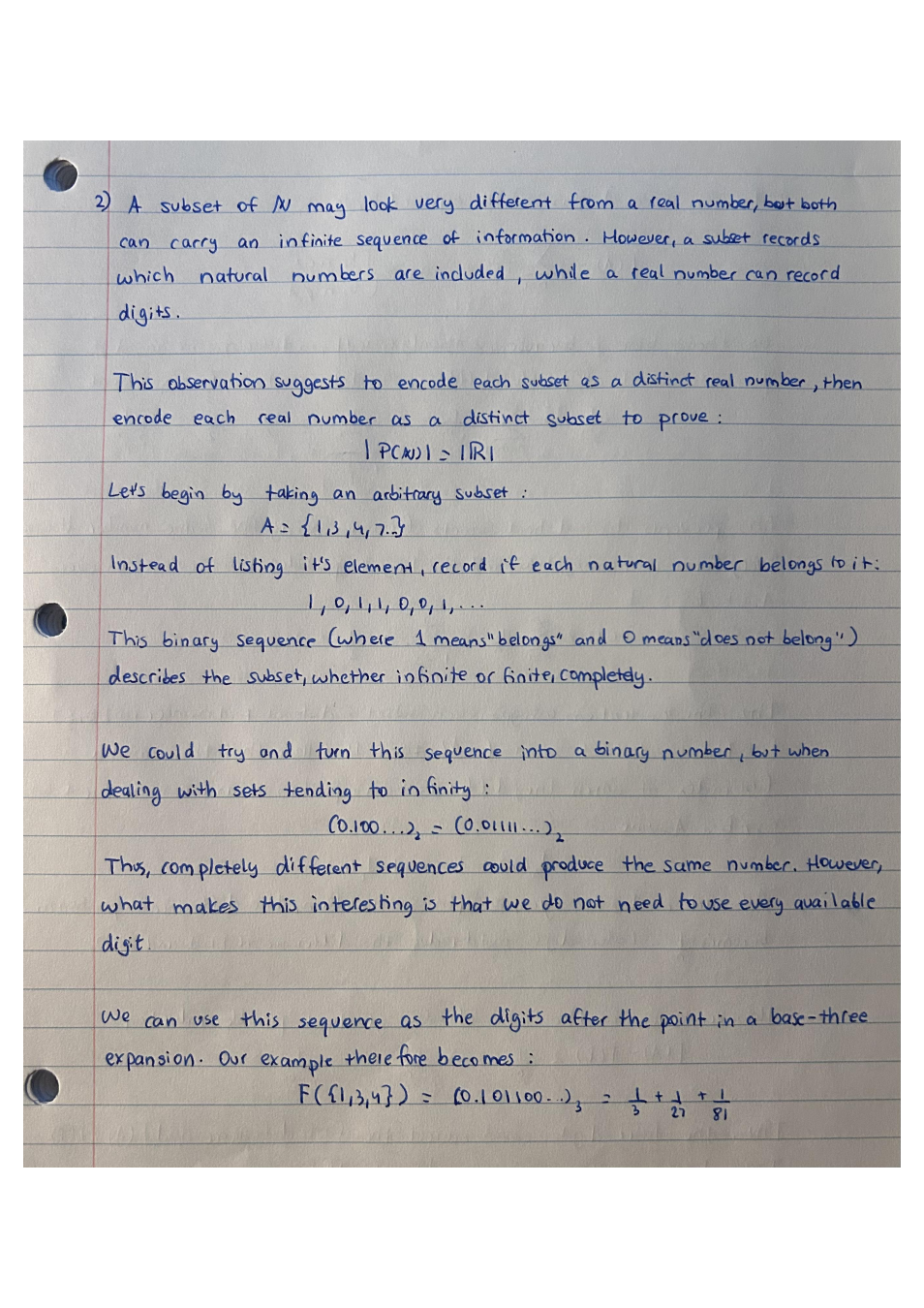
In my notes on the cardinality of the continuum, I worked through how to encode a subset of the positive integers as a real number. Here is one step of that argument.

These are my notes on established mathematics.

Start with a set.

Write a 1 for each integer in the set and a 0 for each integer left out. Then read that sequence after the point in base three.

Choose a subset of {1, 2, …, 8}

A = { 1, 3, 4 }

0.10110000000…3

Decimal value ≈ 0.38271605

This example uses eight integers; every later digit is zero. The argument also works for infinite subsets.

Why change the base?

In base two, 0.1000… and 0.0111… are equal. They both represent one half, even though their digits describe different sets.

0.1000…2 = 0.0111…2

In base three, using only 0 and 1 prevents that collision. At the first place where two sequences differ, the difference outweighs everything that can follow.

See why the later digits cannot cancel it

If the first differing position is k, its contribution is 3−k. The greatest possible offset from all later positions is

∑n > k 3−n = ½ · 3−k.

That is only half as large. The two real numbers must therefore be different.

This establishes an injection into the reals. Equal cardinality also requires the reverse direction; original page 4 supplies the reverse injection and completes the equality.

Three pages,
one correction.

This excerpt includes only original pages 2–4: encoding sets, proving the map is injective, and constructing the reverse injection.

A correction to page 3: the final line claims equality too soon. At that point, the proof establishes only |℘(ℕ)| ≤ |ℝ|. Page 4 supplies the reverse injection; Cantor–Schröder–Bernstein then gives equality.

The scan is unchanged. These are notes on established mathematics, with the correction recorded here.

Turn the three pages →
Download excerpt (PDF) ↗
My handwritten argument: encode a subset using zeroes and ones, then use base three to avoid duplicate expansions.
My handwriting, original page 2.
Three-page excerpt · original pages 2–4.
Turn the pages →

The Cardinality of the Continuum

Original page 2 · 1 of 3

Original page 2: encoding sets as sequences, then switching from binary to ternary.

From sets to sequences. Base three avoids the duplicate binary expansions.

Download the three-page excerpt ↗

Pages from my research

Page 14 · Main results

Page 14 of the working paper, showing Table 3 and Figure 2.
Open this page image ↗